> ## Documentation Index
> Fetch the complete documentation index at: https://docs.peerdb.io/llms.txt
> Use this file to discover all available pages before exploring further.
# PeerDB Lua Scripting
PeerDB uses [Gopher Lua](https://github.com/yuin/gopher-lua) for scripting
See [examples](https://github.com/PeerDB-io/examples) for sample scripts
Scripts can be added & edited in UI:
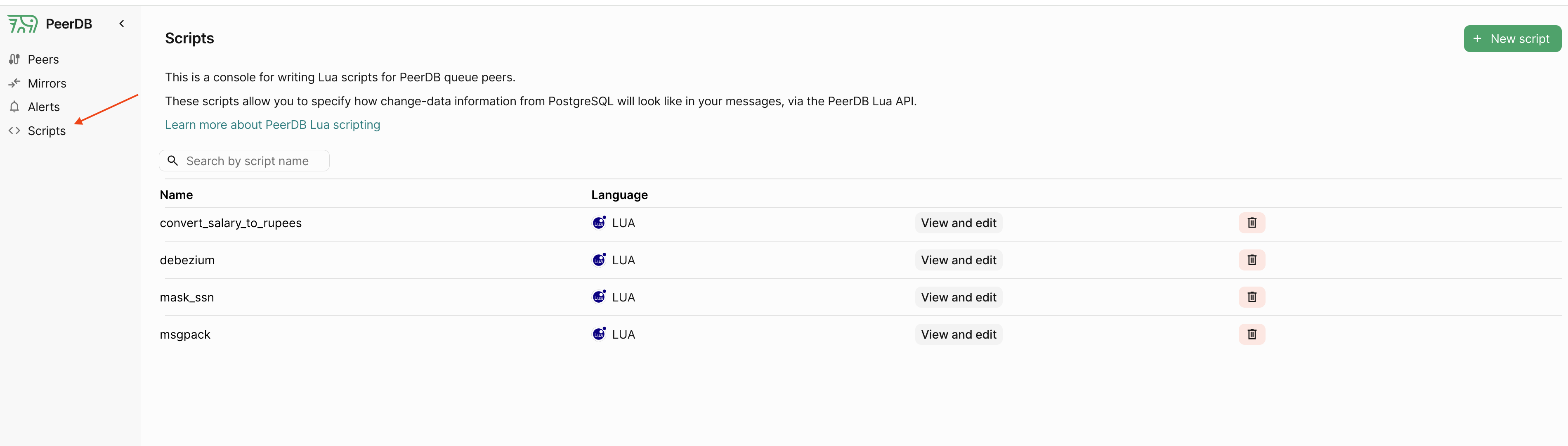
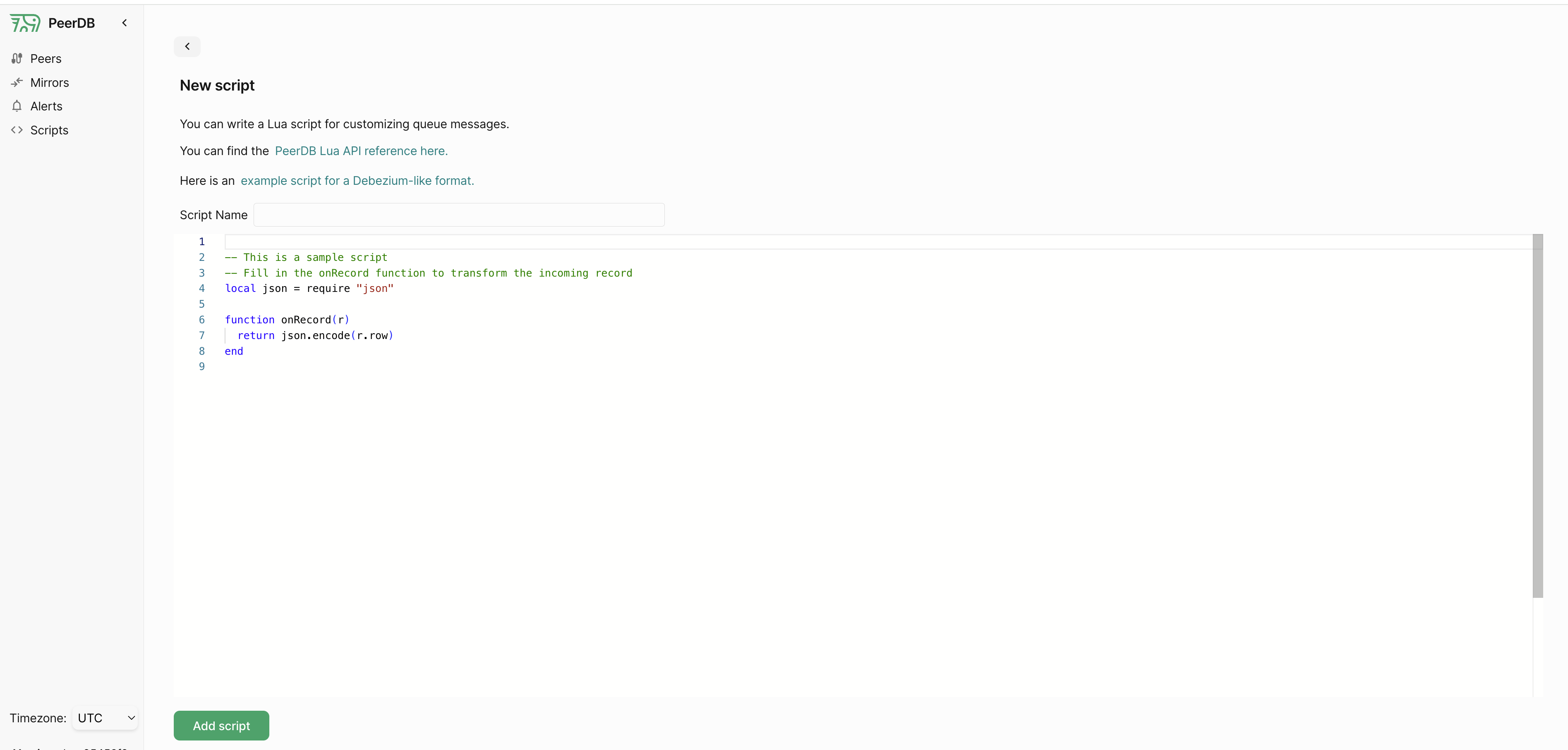 PeerDB Streams supports an `onRecord` function for complete control of message content. Result may be a table instead of a string to specify partition key, metadata, etc. See queue specific pages for supported fields. If multiple return values are given, multiple records will be written
For qrep mirrors `transformRow` can be defined. Row fields can be set to transform row. Schema may not be modified
For cdc mirrors `transformRow` will be called on the record's rows by default, unless `tranformRecord` is defined. The latter can be useful for comparing old & new field values
# `peerdb` functions
The set of functions in global `peerdb` table are:
#### `RowColumns(row) table`
Returns array of row's column names
#### `RowColumnKind(row, column) string`
Returns underlying `Kind` of row column, see [qvalue/kind.go](https://github.com/PeerDB-io/peerdb/blob/main/flow/model/qvalue/kind.go) for list of kinds
#### `Now() [Time]`
Returns current time as `[Time]`
#### `UUID(string?) [UUID]`
Returns random `[UUID]`, or parses passed in string
#### `Decimal(string | number)`
Returns Decimal based on passed in value
#### `type(any) string`
Returns `fmt.Sprintf("%T", value)` on underlying value of UserData. Returns `nil` for other types
#### `tostring(any) string`
Returns `fmt.Sprint(value)` on underlying value of UserData. Returns `nil` for other types
# types
PeerDB exposes records as UserData:
## `Record`
Represents a CDC change
#### `kind`
One of `insert`, `update`, `delete`, or `relation`. You will likely want to ignore `relation` messages
#### `row`
Canonical row values of change. For `update` this is the new row. Keep in mind that Postgres does not send unchanged toast column values in CDC updates
#### `old`
Previous row values, `nil` for insert
#### `new`
New row values, `nil` for delete
#### `checkpoint`
LSN of CDC message
#### `commit_time`
CommitTime of record's preceding BeginMessage
#### `target`
Destination table of record defined by mirror
#### `source`
Source table of record
#### `unchanged_columns`
Update records have a table mapping unchanged [toast](https://www.postgresql.org/docs/current/storage-toast.html) columns to `true`
## `Row`
PeerDB row values which cannot be represented as Lua numbers or strings are wrapped in UserData. All of these types implement `__tostring`. Available types:
#### `I64` / `U64`
Represents signed/unsigned 64 bit integers. Implements comparisons with each other & `__tostring` support. There are 3 conversion properties:
* `i64` cast to `[I64]`
* `u64` cast to `[U64]`
* `float64` cast to lua number
* `hi` returns highest 32 bits as an unsigned number
* `lo` returns lowest 32 bits as an unsigned number
## `Time`
Has properties for durations since Unix epoch. These are `[I64]` results, except `unix` which is a lua number
* unix\_nano
* unix\_micro
* unix\_milli
* unix\_second
* unix
& properties for datetime components as numbers:
* year
* month
* day
* yearday
* hour
* minute
* second
* nanosecond
## `UUID`
Index with `[0..16)` to access bytes *(first element at index 0)*
## `BigInt`
#### `sign`
`1`, `0`, or `-1` depending on sign of value
#### `bytes`
string of `*big.Int` Bytes method
#### `int64`
value as `[I64]`
#### `is64`
whether value can be represented by `int64`
## `Decimal`
#### `coefficient`
`[BigInt]` representing digits
#### `coefficient64`
`[I64]` representing digits
#### `exponent`
Exponent, value of decimal is `coefficient * (10 ^ exponent)`
#### `bigint`
Value of decimal as a `BigInt`
#### `int64`
Value of decimal as a `[I64]`
#### `float`
Value of decimal as a number
# package.preload
PeerDB offers some preloaded libraries, accessible via `require`:
| library | description |
| --------------------------------------------------- | ------------------------------------------------------------------------------- |
| [bit32](https://github.com/PeerDB-io/gluabit32) | [bit32 API included in Lua 5.2](https://www.lua.org/manual/5.2/manual.html#6.7) |
| [json](https://github.com/PeerDB-io/gluajson) | [JSON](https://json.org) encoding/decoding |
| [msgpack](https://github.com/PeerDB-io/gluamsgpack) | [msgpack](https://msgpack.org) encoding |
| [utf8](https://github.com/PeerDB-io/gluautf8) | [utf8 API included in Lua 5.3](https://www.lua.org/manual/5.3/manual.html#6.5) |
PeerDB Streams supports an `onRecord` function for complete control of message content. Result may be a table instead of a string to specify partition key, metadata, etc. See queue specific pages for supported fields. If multiple return values are given, multiple records will be written
For qrep mirrors `transformRow` can be defined. Row fields can be set to transform row. Schema may not be modified
For cdc mirrors `transformRow` will be called on the record's rows by default, unless `tranformRecord` is defined. The latter can be useful for comparing old & new field values
# `peerdb` functions
The set of functions in global `peerdb` table are:
#### `RowColumns(row) table`
Returns array of row's column names
#### `RowColumnKind(row, column) string`
Returns underlying `Kind` of row column, see [qvalue/kind.go](https://github.com/PeerDB-io/peerdb/blob/main/flow/model/qvalue/kind.go) for list of kinds
#### `Now() [Time]`
Returns current time as `[Time]`
#### `UUID(string?) [UUID]`
Returns random `[UUID]`, or parses passed in string
#### `Decimal(string | number)`
Returns Decimal based on passed in value
#### `type(any) string`
Returns `fmt.Sprintf("%T", value)` on underlying value of UserData. Returns `nil` for other types
#### `tostring(any) string`
Returns `fmt.Sprint(value)` on underlying value of UserData. Returns `nil` for other types
# types
PeerDB exposes records as UserData:
## `Record`
Represents a CDC change
#### `kind`
One of `insert`, `update`, `delete`, or `relation`. You will likely want to ignore `relation` messages
#### `row`
Canonical row values of change. For `update` this is the new row. Keep in mind that Postgres does not send unchanged toast column values in CDC updates
#### `old`
Previous row values, `nil` for insert
#### `new`
New row values, `nil` for delete
#### `checkpoint`
LSN of CDC message
#### `commit_time`
CommitTime of record's preceding BeginMessage
#### `target`
Destination table of record defined by mirror
#### `source`
Source table of record
#### `unchanged_columns`
Update records have a table mapping unchanged [toast](https://www.postgresql.org/docs/current/storage-toast.html) columns to `true`
## `Row`
PeerDB row values which cannot be represented as Lua numbers or strings are wrapped in UserData. All of these types implement `__tostring`. Available types:
#### `I64` / `U64`
Represents signed/unsigned 64 bit integers. Implements comparisons with each other & `__tostring` support. There are 3 conversion properties:
* `i64` cast to `[I64]`
* `u64` cast to `[U64]`
* `float64` cast to lua number
* `hi` returns highest 32 bits as an unsigned number
* `lo` returns lowest 32 bits as an unsigned number
## `Time`
Has properties for durations since Unix epoch. These are `[I64]` results, except `unix` which is a lua number
* unix\_nano
* unix\_micro
* unix\_milli
* unix\_second
* unix
& properties for datetime components as numbers:
* year
* month
* day
* yearday
* hour
* minute
* second
* nanosecond
## `UUID`
Index with `[0..16)` to access bytes *(first element at index 0)*
## `BigInt`
#### `sign`
`1`, `0`, or `-1` depending on sign of value
#### `bytes`
string of `*big.Int` Bytes method
#### `int64`
value as `[I64]`
#### `is64`
whether value can be represented by `int64`
## `Decimal`
#### `coefficient`
`[BigInt]` representing digits
#### `coefficient64`
`[I64]` representing digits
#### `exponent`
Exponent, value of decimal is `coefficient * (10 ^ exponent)`
#### `bigint`
Value of decimal as a `BigInt`
#### `int64`
Value of decimal as a `[I64]`
#### `float`
Value of decimal as a number
# package.preload
PeerDB offers some preloaded libraries, accessible via `require`:
| library | description |
| --------------------------------------------------- | ------------------------------------------------------------------------------- |
| [bit32](https://github.com/PeerDB-io/gluabit32) | [bit32 API included in Lua 5.2](https://www.lua.org/manual/5.2/manual.html#6.7) |
| [json](https://github.com/PeerDB-io/gluajson) | [JSON](https://json.org) encoding/decoding |
| [msgpack](https://github.com/PeerDB-io/gluamsgpack) | [msgpack](https://msgpack.org) encoding |
| [utf8](https://github.com/PeerDB-io/gluautf8) | [utf8 API included in Lua 5.3](https://www.lua.org/manual/5.3/manual.html#6.5) |